Do You Need Septic or Sewer When Building a Home?
Every home requires a waste management system: either a connection to the public sewer system or a private septic system on the parcel.
Which system applies to your build is determined by whether your specific parcel is within the service area of the public sewer system or not.
In Cedar City, most parcels within the city limits are served by the public sewer.
Every rural parcel in Iron County (parcels outside city limits) usually requires a private septic system.
HOW TO DETERMINE WHICH APPLIES TO YOUR PARCEL
Figuring out whether your parcel connects to public sewer or needs a private septic system is usually a fairly simple process. A quick call to the city's Public Works Department will give you a clear answer.
This is also something we cover as part of the free consultation. If you are already in touch with Summit about a potential build, we can give you a reliable assessment on this right away based on our regional knowledge.
While some property listings mention sewer availability, it is always best to verify directly with the appropriate utility authority to be sure you are getting accurate, up-to-date information.
PUBLIC SEWER CONNECTION: WHAT IT COSTS
Connecting a new home to the public sewer system involves a sewer service line run to the property and a sewer connection fee charged by the local utility supply company.
Cedar City's sewer connection fee for new residential construction varies by the size of the service package. Contact Cedar City Public Works for the current fee schedule.
The cost of the service line depends on the distance from the existing sewer main to the property. The further the property is from the main, the more significant that cost becomes.
PRIVATE SEPTIC SYSTEM: WHAT IT COSTS AND HOW IT WORKS
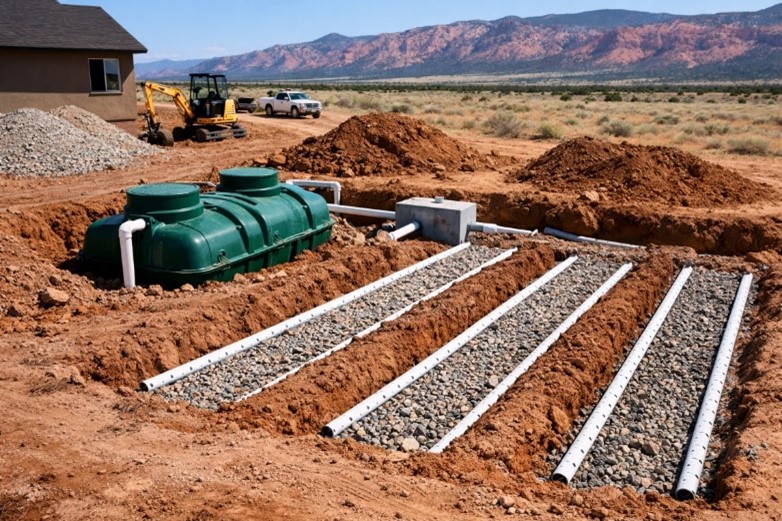
A private septic system on a rural parcel includes two main components: a concrete or watertight plastic tank that receives all household wastewater and a series of perforated pipes in gravel trenches that allow the treated effluent to percolate into the soil.
Parcels with challenging soil conditions may require an engineered alternative such as a mound system or drip system.
The size of the septic system required for your parcel is determined by the home's bedroom count and soil conditions.
Both depend on the results of the formal percolation test, which is conducted after the preconstruction contract is in place. That size is important to determine early as it affects both the footprint required on the parcel and the overall cost.
THE PERCOLATION TEST: WHAT IT IS AND WHY IT MATTERS
The percolation test is the most important step in determining septic viability for any rural parcel without a public sewer connection. It determines whether the parcel's soil can support a conventional drain field — and if not, whether an engineered alternative is viable.
A failed percolation test with no viable alternative makes a parcel entirely unusable for residential building.
As part of your initial consultation, Benjamin can walk the parcel with you and give you an experienced assessment on what the soil is likely to support.
The formal percolation test is conducted as part of the engineering process immediately after the preconstruction contract is in place.
Get Your Questions Answered
In a free 45-minute consultation you will walk away with a realistic budget range, an estimated timeline from planning through move-in, and a clear recommended next step forward.
No obligation. No pressure. Just clarity.
"Septic viability is one of the first things I look at on any rural property, because without a viable septic system, the parcel simply cannot support a home.
So, having an early sense of what the soil is likely to allow helps you make an informed decision whether to move forward or to take a closer look before committing.
It is an important piece of the puzzle we can help you consider as you evaluate property for your home."

— Benjamin Barlow, Owner
Summit Building Construction
25+ Years Building in Southern Utah
PEOPLE ALSO ASK
How do I know if my land needs a septic system?
That depends on whether it has access to public sewer or not.
In Southern Utah, every parcel within Cedar City limits connect to the public sewer system. Most rural parcels in Iron County requires a private septic system.
To confirm which applies, contact Cedar City's Public Works Department.
We can also give you a reliable assessment on this as part of the free consultation.
How much does a septic system cost for a new home?
The cost of a septic system for a new home in Southern Utah depends on the size of system required and the soil conditions of the specific parcel, which are determined through a formal percolation test conducted after the preconstruction contract is in place.
What is a septic system and how does it work?
A septic system is a private onsite waste management system consisting of a septic tank and a drain field.
The tank receives all household wastewater, separates solids from liquids, and provides primary treatment. The treated liquid (effluent) flows into the drain field, where it percolates through perforated pipes into gravel and then into the surrounding soil, completing the treatment process.
The system requires periodic pumping every three to five years, and the drain field should be kept protected from physical damage and root intrusion.
Trusted custom home builder serving homeowners for over 25 years